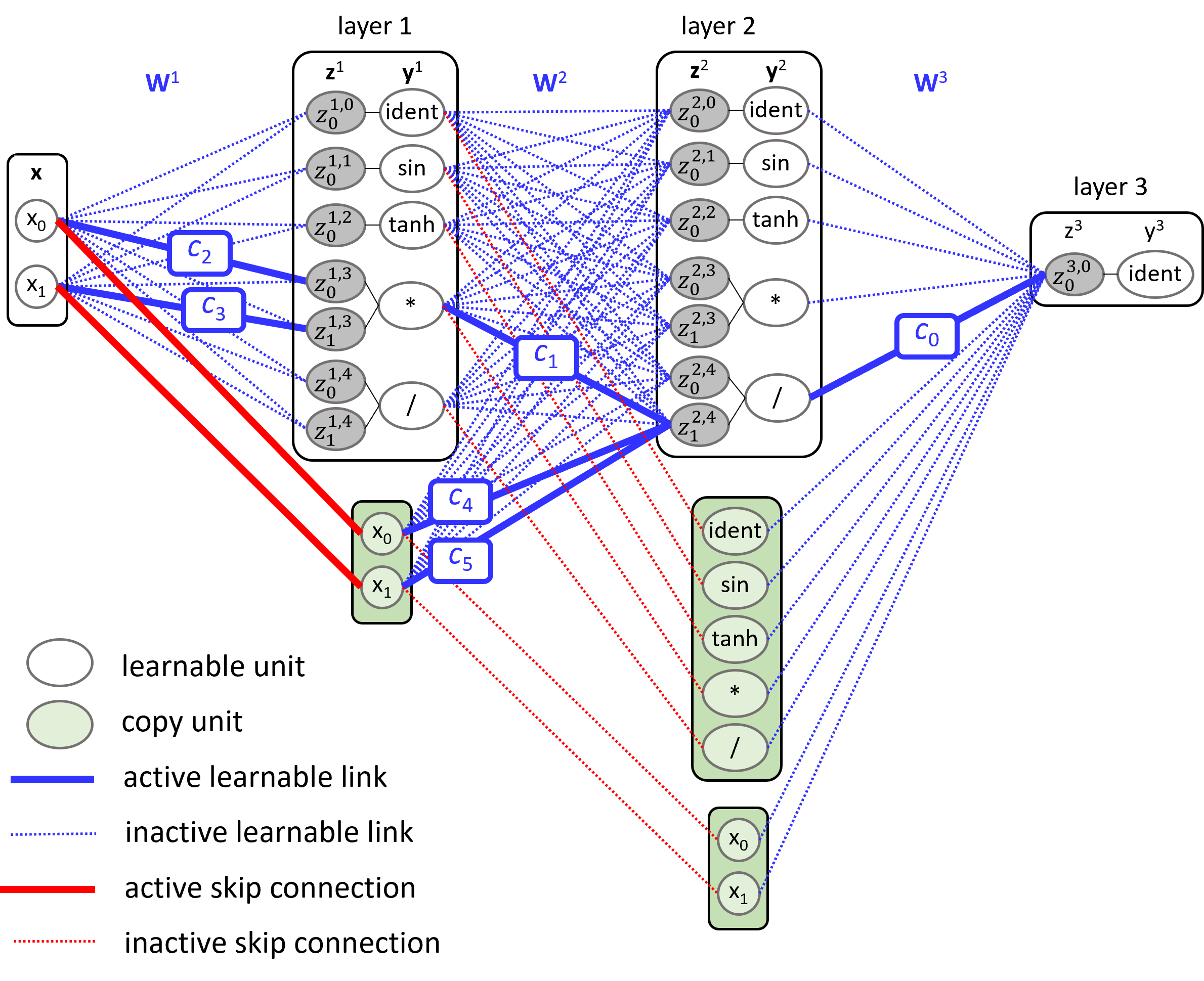
We consider a neuro-evolutionary symbolic regression, an approach in which mathematical formulas are internally represented by feedforward neural networks. Gradient-free global exploration of the network topology space is combined with gradient-based parameter learning.
From the perspective of evolutionary algorithms, this approach has a potential weakness: newly generated networks produced by genetic operators usually require intensive parameter tuning. If this optimization has not yet converged, such networks may be prematurely discarded due to poor performance, thereby losing the opportunity to contribute their true potential to the evolutionary process. Such a waste of innovative, potentially promising topologies can reduce the algorithm's efficiency.
To address this limitation, we propose a neuro-evolutionary algorithm that relies on asynchronous refinement of network parameters and a maturity-based replacement strategy. Thus, newly created networks are allowed to coexist and develop alongside their parental networks, while being compared only with peers of similar maturity. The proposed method was evaluated on six benchmarks and compared to the original evolutionary approach.
Solution obtained using the approximation of sin(2.7 x) = 2 sin(1.35 x) cos(1.35 x)